
If there’s no sodium hydroxide, it’s not soap.
by Tamara Neale
The Truth About Traditional Soap Making
Traditional soap making isn’t new.
It didn’t start with “clean beauty.”
And it didn’t come from a lab trying to simplify ingredients.
It dates back thousands of years - long before marketing had anything to do with it.
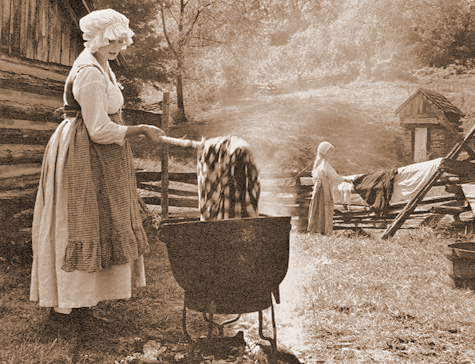

Before labs, before refined ingredients, people made lye from what they had.
Wood ash.
Water.
Time.
Water was slowly poured through ash, pulling out natural potassium salts. That liquid - collected drop by drop - became lye. Simple. Resourceful. Effective.
This wasn’t theory.
This was daily life.
The earliest recorded soap-like substance shows up in the Babylonian civilization around 2800 BC, made by combining fats with ash.
Not because it was trendy. But because it worked.
Written Proof: This Was a Process, Not a Guess
By the time we get to the early Middle Ages, soap making wasn’t just being practiced - it was being documented.
A Latin text known as Mappae Clavicula (dating roughly between the 8th and 12th centuries) outlines the process in detail:
Ashes spread over a woven surface.
Hot water poured slowly through.
The liquid collected, strained, and strengthened.
The Foundation Has Never Changed
The Ancient Romans used soap for cleaning textiles and eventually for bathing.
Regions like Castile became known for olive oil-based soaps - formulations still replicated today, in studios like mine.
And across every version of this process, the foundation stayed the same:
Lye.
Fat or oil.
Time.
What’s Actually Happening (And Why It Matters)
What we now call Saponification has always been at the core of cold process soap making - even before people had the language for it.
When lye and oils combine, they don’t sit side by side.
They transform.
The lye is consumed in the reaction.
The oils are converted. And what’s created is something entirely new:
Cold-Process Soap - the kind I craft for you!
it's a stable, skin-safe compound - along with naturally occurring glycerin — that has been trusted and used for generations.
Let’s Clear Something Up
There’s a lot of fear around the word “lye.”
And honestly - it makes sense.
On its own, it’s a caustic substance.
But that’s not what ends up in your soap.
A properly formulated, properly cured bar contains no active lye.
What remains is the result of the reaction —-not the raw ingredient.
A well-made bar is balanced.
It’s gentle.
It’s reliable.
And it’s exactly what it was always meant to be.
What Is (and Isn’t) Soap
Here’s where things get blurred.
Real soap is made with fat + lye.
That’s not an opinion - that’s the definition.
If it doesn’t use lye, it isn’t actually soap.
That’s why many commercial products use terms like “beauty bar” instead.
They’re often made with synthetic detergents and surfactants rather than through true saponification.
That doesn’t automatically make them bad - but it does make them something different.
And that difference really matters.
A Process That Has Held Up
When people question sodium hydroxide in soap, they’re not questioning a modern ingredient. They’re questioning the very process that soap is built on. And for me and what I craft that process hasn’t changed.
From ash and water dripping through a wooden hopper…
to small-batch bars curing on a rack in a coastal studio…
It’s still the same transformation. Only now, we hopefully all understand it a little better.
A Return to What Works
Traditional soap making has stood the test of time for a reason.
It’s simple.
It’s effective.
And when it’s done with care, it creates something you can trust in your home.
Not because it’s marketed that way - but because it always has been.